Casting About with Captain Nico

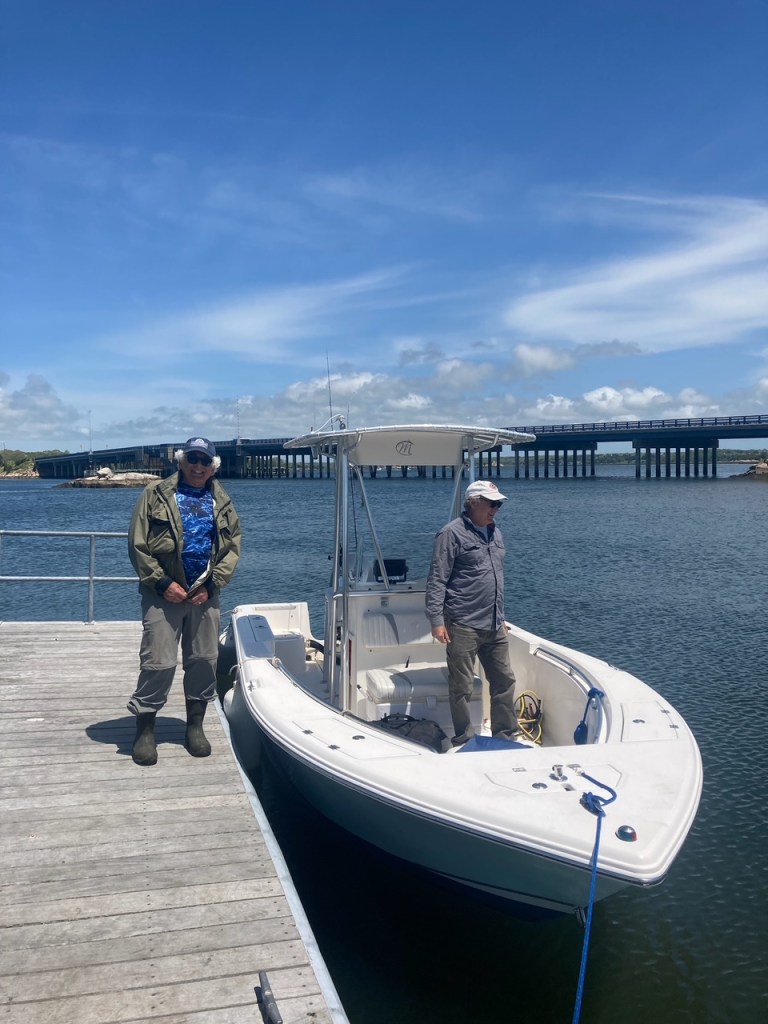
USCG Licensed Captain Nico takes charters out of Westport MA for light tackle fishing in Westport and Sakonnet rivers, Buzzards Bay, Elizabeth Islands. As a Registered Maine Fly Fishing Guide out of Kennebago Lake Maine, he takes float and wade trips in the rivers and lakes in the Rangeley Region for salmon, trout, and bass. He offers instruction in fly casting and fly tying.
Contact and Bookings
gofish@captain-nico.com
Fishing





Boating





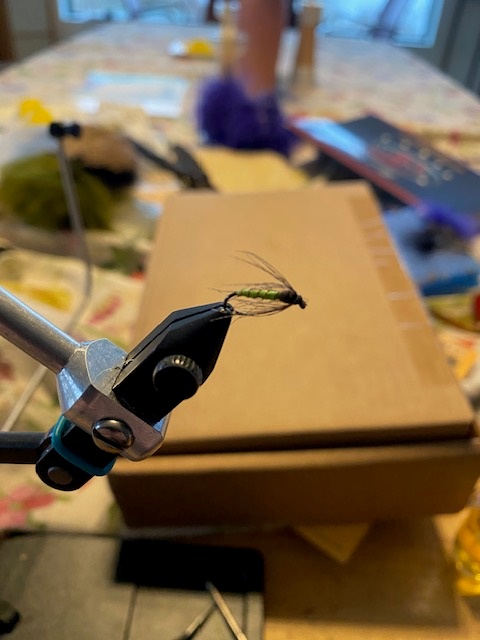
Fly Tying

Bloviating
More bogus fishing physics: the large arbor reel
Like any proper kinematical exposition, let’s start by defining terms.
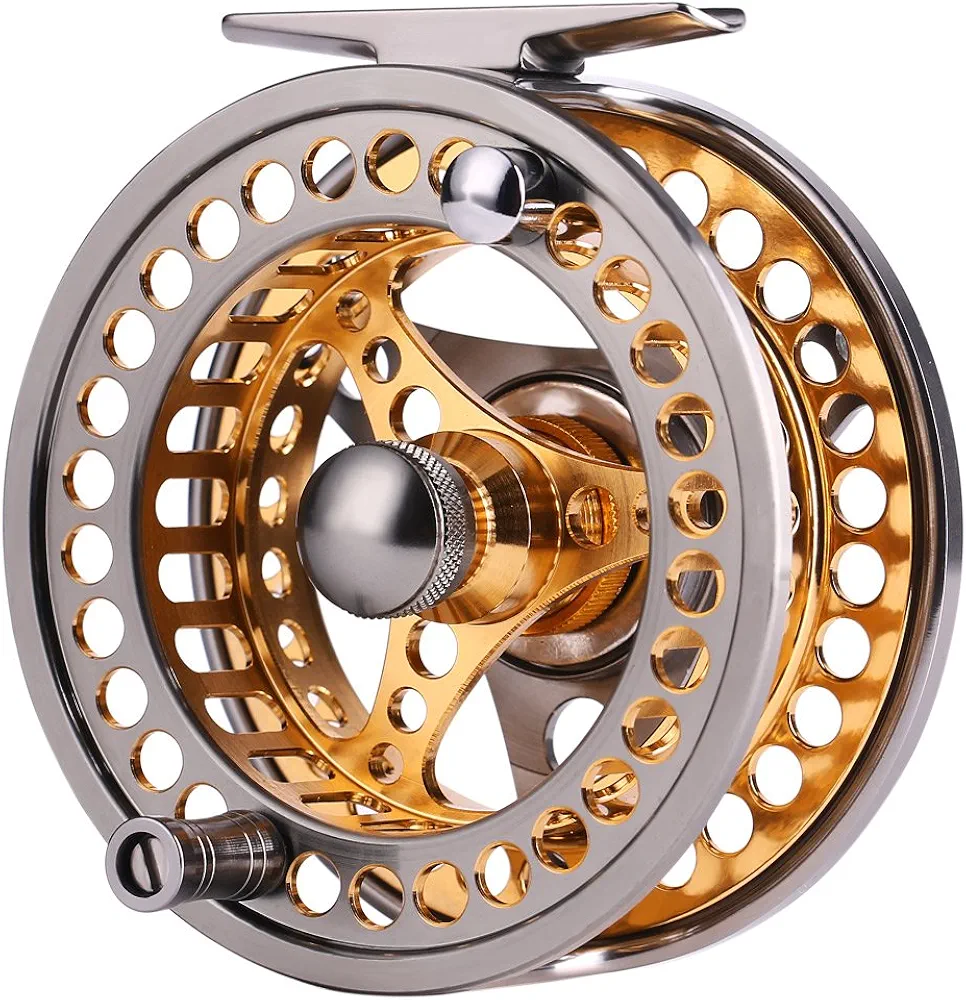
Arbor – that portion of a fishing reel that forms the inside diameter of the reel.
Pick Up Rate – the rate at which line is retrieved onto the reel.
Rate – the change in one measure with respect to another, e.g. miles per hour.
The principal claim is that large arbor reels provide faster pick up rate. The argument is that with each revolution, the length of line retrieved equals the circumference of the reel. As more line is wound on, the effective radius of the reel grows, as does the circumference. A larger diameter reel means a larger circumference and thus more line retrieved per turn. Mathematically true. In this way, a small arbor reel and a large arbor reel wound up to the same diameter retrieve exactly the same amount of line per turn. The size of the arbor has no impact.
It is important to look closely at the definition of rate. It is the change is one measure with respect to another. For the “one measure” we choose length of line retrieved. For the “other measure” we have chosen per revolution; if instead we look at the rate of retrieval per distance moved by your hand, we find that arbor size irrelevant, as is effective radius of the spool. Let’s assume the spool is filled to the point where the handle is. Then, with each full turn, the ratio of line retrieved to the distance the handle is moved is 1. It is always 1 regardless of the arbor size or the outer diameter of the reel.
The upshot is this: when the spool is wound up to the handle, the speed of line retrieval (length per second) depends on how fast you reel, not on the arbor size, and not on the reel size.
The Curse of the North
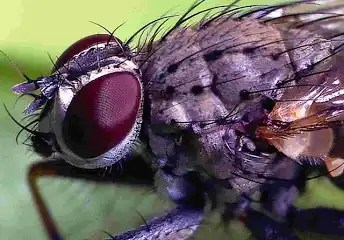
You do not learn about them in fly-fishing school. You do not read about them in glossy lodge brochures. Nothing in equipment catalogs. But if you go up north to catch the peak spring fishing, they will be waiting for you: dozens, hundreds, thousands of them. What are they? They are Black Flies.
You can forget about the sophisticated fly-casting techniques: the double-haul, the roll cast, the upstream mended pile cast… these techniques mean nothing when you are in the teeth of a Black Fly onslaught. I have seen grown men running from the riverbank in tears. I am not talking about wimpy desk-job men, but rather tough outdoorsy men who drink yesterday’s coffee and carve SPAM with their Buck knives.
From the road, you have probably seen those “friendly fishermen” who always seem to be waving to you, right? Well, wise up. They do not wave to you. They probably do not even see you through the swarm of Black Flies. Stop and ask “how are the bugs?” and the experienced angler probably will adhere to the unspoken code and reply “Bugs? No bugs over here.” This usually draws a chuckle from any fellow sufferers within earshot. The cruel joke frequently plays out as a hapless tourist ventures out to the stream in an open shirt and shorts. How “friendly” is that?
Black Flies can even cause a life-changing experience. I heard of one fisherman who abruptly abandoned his brand new, top-of the-line gear, jumped into his truck and drove off muttering the entire ride home. The sad thing is it did not have to happen. But this angler was simply not prepared, physically or mentally, for what he encountered on the river.
Some years back, I had something of a Black Fly epiphany while standing beside one of the storied salmon pools in northern Maine on a mid-June afternoon. A heavy flow roared down the sluiceway into a huge churning pool that held countless fish. Two people fished near each other. One wore a hooded green sweatshirt with the drawstring pulled tight exposing only his eyes. He caught fish after fish with machine-like focus and precision. The other wore a loose Hawaiian print shirt. He was preoccupied with a brutal swarm of Black Flies. His skin was ravaged, and bleeding and he caught nothing. I realized then that the Black Fly can be beaten. But it is not easy.
Under favorable conditions, the Black Fly can be outwitted, outmaneuvered, and overcome. But she should not be underestimated. The pronoun is “she” because only the female Black Fly bites. Make no mistake, the rivers and ponds in the north country belong to the Black Fly and they have no intention of ceding their territory. They are the predator. We are the prey. Entomologists use the term “exsanguination” to describe how an extreme number of insect bites can drain you of blood. Usually, this is fatal only to birds.
The Black Fly employs a coordinated strategy combining air and ground assault with chemical and psychological tactics. To defeat the Black Fly on her territory, we must know the enemy and exploit her weaknesses. No quarter is asked or given.
Like most modern military forces, the Black Fly uses an aerial attack to provide cover while ground troops engage the enemy directly in bloody trench warfare. They can count on having superiority in numbers and individuals willing to die for their cause. The sight of their own casualties seems to incite their fervor. So, it is often wiser to simply frustrate them, or to eliminate them discreetly, rather than squash them in plain sight.
The first sign of danger is a perceptible stillness in the air. This is because Black Flies cannot bear windy conditions. On a windless day, you can feel relatively safe in a fast-moving boat or automobile, but do not be lulled into a false sense of security. Eventually you will have to stop the boat or car and you will again be at risk. Even in a stiff breeze, the boldest members of the Black Fly horde will adopt a crawl and bite strategy once they get under your clothing.
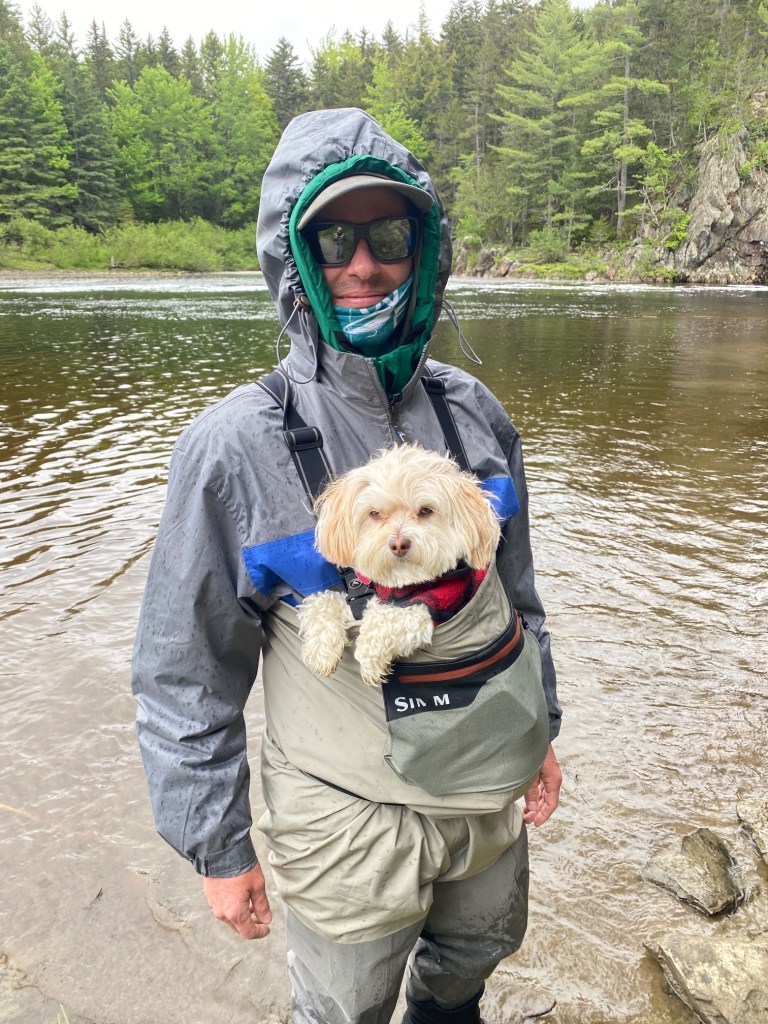
Frustrating the formidable ground attack is key. The most basic defense is proper clothing with the goal of total skin coverage. A loose pant leg is like a giant flashing neon sign saying “Come on in. Bite me here!” Some clothing rules apply:
RULE 1: Tuck those pants into your socks. Leave the loosely woven socks at home. My worst moment of Black Fly induced hysteria occurred on the banks of the Roach River in Maine. A scouting party of Black Flies, entering at my pants cuff, marched all the way up my leg. Setting up camp inside my underwear, they broke for lunch. Desperate and hyperventilating, I stripped down right there and wildly flailing my arms, managed to turn back the invasion. I still experience flashbacks from that moment.
RULE 2: Never let your shirt get untucked from your pants. Not the tiniest crack. My friend Kevin received a ring of bites that resembled a red leather belt because he let a shirt tail flap.
RULE 3: Leave no holes. This means no open collars and no shirts with cuff openings. People who do not need to be able to see their dry fly float can wear head nets, but for the rest of us the exposed eyes, face, ears, neck, and scalp remain problematic.
Black Flies do more than fly, crawl, and bite. They manufacture chemical agents that they deploy to the bite site. They use anesthetics so that you don’t feel the bite. Then they apply anti-coagulants to keep the wound open. Their saliva is toxic and triggers the swelling and itching reaction. Since, clearly, the Black Fly initiated the use of chemical weapons, you should not consider it morally reprehensible to retaliate in kind.
The most commonly used chemical deterrent is DEET (N,N-diethyl-meta-toluamide) and is best used at 100 percent concentration. Contrary to the instructions on the bottle, a few drops will not do the job. At approximately one-thousand times the recommended dosage, when the fumes become visible, I have found it to very effective, if applied repeatedly. Of course it is probably toxic to humans at this exposure. And it burns the eyes, lips, and any open cuts. It removes the finish from expensive fly rods, makes tippet material rough and brittle, and turns fly lines into a gooey mess. It also melts the steering wheel of the Dodge Caravan. So, use with caution.
Another carcinogenic chemical deterrent is cigar smoke. I have found that immersing your head in a continual cloud of smoke is effective. Is cigar smoke more toxic than DEET?
Acting individually, the Black Fly poses no great threat. But as a cooperative swarm they almost always hit their mark. Their numbers allow them to attack on many fronts simultaneously including psychological. From a Black Fly swarm, two or three designated psychological operatives will create a diversion. One common tactic is for the psychological operatives to scurry around on the inside of your sunglasses. For all but the most highly disciplined anglers, this induces a severe disturbance, providing cover for a simultaneous flanking attack. Never underestimate the enemy’s capacity for intelligent group behavior.
Finally, beating the Black Fly requires mental toughness. Picture this scenario: as the sun is going down, the evening caddis hatch begins, and salmon are taking flies on the surface all around you. Time to switch to a number 18 Elk Hair Caddis. You have completed three of the six turns required in the improved clinch knot when you notice there are five Black Flies on your fingers. What do you do? You could stop and swat the flies, but then you will have to start over. You could take a shortcut: stopping at only five turns, but then you risk losing the big fish. Or you can dig deep and find something in your soul that you never knew you had. That is the real stuff of fly-fishing.
Gear Review: Fly Lines
Coming soon
 Casting About with Captain Nico